Barrymore signals to Selden at night
The Hound of the BaskervillesBarrymore’s nighttime signal to Selden turns a suspicious ritual inside Baskerville Hall into a clandestine act of family mercy. Seen first by Dr. Watson as a candle held to a dark window, the signal seemed to confirm fears of a conspiracy; its discovery instead revealed that the butler and Eliza Barrymore were secretly feeding her escaped younger brother, concealed on the moor.
Suspicion in the House
Watson’s first sight of the signal came during a night when he was sleeping lightly while keeping watch at Baskerville Hall. At about two in the morning, a stealthy step passed his room. He opened the door and saw a long shadow moving down the corridor, cast by a man carrying a candle. The figure wore only shirt and trousers and had no shoes; his height identified him to Watson as Barrymore. The butler’s slow, careful progress struck the watcher as furtive and guilty.
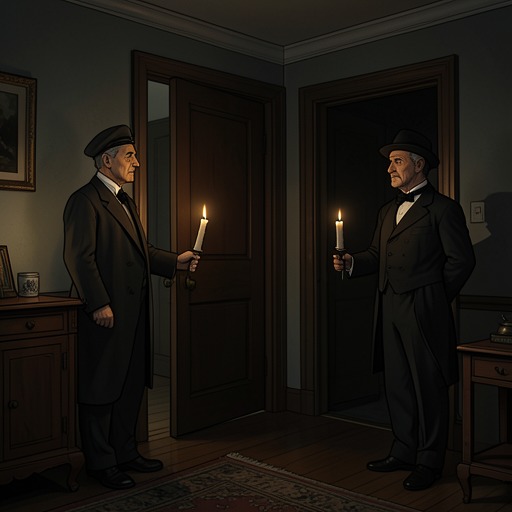
Watson followed after Barrymore disappeared around the balcony that divided the corridor. The rooms in the farther wing were empty, making the light beneath one open door all the more puzzling. Inside, Barrymore crouched at a window with the candle held against the glass, staring out into the darkness over the moor. He remained there for several minutes, apparently waiting. Then he groaned, put out the flame, and retraced his steps. Watson later heard a key turn in a lock but could not identify where. The unexplained candle, the vacant room, and the sound of the lock gathered into a mystery rather than an answer.
The scene also sharpened Watson’s unease about the household. He had already observed traces of tears on Mrs. Barrymore’s face and had once heard her sob bitterly. Her reserved, respectable manner seemed at odds with a sorrow that appeared to persist beneath it. Watson wondered whether she was haunted by a guilty memory, or whether Barrymore ruled her harshly; neither suspicion was established, but the nocturnal errand made him connect her distress with a possible secret in the house. He told Sherlock Holmes that he would report facts rather than theories, and planned with Sir Henry to investigate further.
The Watch and the Pursuit
The first attempt to catch Barrymore’s purpose produced nothing. Watson and Sir Henry stayed awake in the baronet’s rooms until nearly three, hearing only the clock on the stairs, and both eventually fell asleep in their chairs. Rather than abandon their suspicion, they tried again the following night. They lowered the lamp and sat smoking in silence, waiting through the slow hours. At one o’clock, then two, no movement came; when they were close to giving up, a creaking step sounded in the passage.
They followed Barrymore through the gallery and into the other wing. Sir Henry and Watson had left their boots behind, yet the old boards still snapped beneath their careful steps. Ahead, Barrymore passed through the same door as before, and the candle sent a single yellow beam across the dark corridor. When the two men peered into the room, they found him crouched at the window again, his face pressed close to the pane and his attention fixed beyond it. His deafness and absorption in what he was doing had kept him from hearing their approach.
This time the pursuit became a direct confrontation. Sir Henry entered the room, startling Barrymore from his vigil. The butler stood trembling, his face pale and his eyes fixed in horror on Sir Henry and Watson. Asked what he was doing, he claimed he was checking whether the windows were fastened. Sir Henry pointed out that this was the second floor. When pressed about the candle, Barrymore refused to disclose his secret, insisting that it was not his alone to tell and that he would not betray it. Sir Henry threatened to dismiss him, invoking the long service of Barrymore’s family beneath the same roof and accusing him of plotting against the household.
The Light Answered
Watson took the candle from Barrymore’s trembling hand and tested the suspicion that it was a signal. He held it at the window as the butler had done and looked out. The moon was behind clouds; beyond the dark line of trees lay the lighter stretch of the moor. Then a tiny yellow point appeared in the distance and held steady within the window’s dark frame. The isolated light supplied what Watson’s first observation could not: evidence that someone outside was responding.
At Sir Henry’s direction, Watson moved the candle across the window. The distant light moved too. The matching motion confirmed that the two lights were connected, and Sir Henry demanded to know who Barrymore’s confederate was and what conspiracy they were conducting. Barrymore, no longer offering the explanation about the window, answered that the matter was his business and refused to speak. Before Sir Henry could carry out his threat, Mrs. Barrymore appeared at the door. She was pale and alarmed, and immediately denied that the plot was directed against Sir Henry.
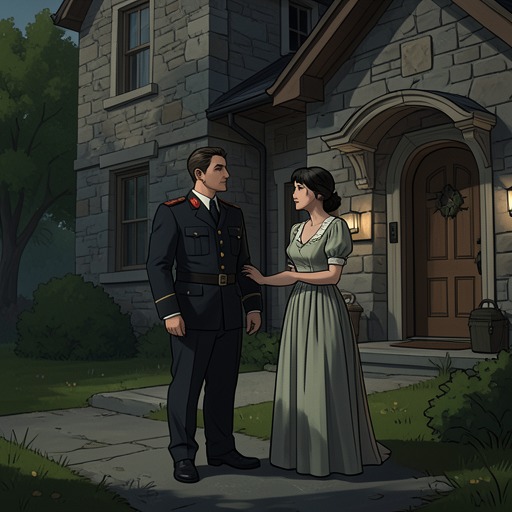
Barrymore told his wife they would have to leave and instructed her to pack their things. Eliza Barrymore stopped that departure by taking responsibility herself: she said her husband had acted at her request and for her sake. The revelation transformed the apparent betrayal into a secret act of assistance. The light in the house told someone on the moor that food was ready; the answering light indicated where it should be taken.
Selden’s Refuge and the Signal’s Meaning
The person outside was Selden, the escaped convict and Eliza Barrymore’s younger brother. She explained that he was starving on the moor, and that she and her husband could not let him perish close to their own gates. When Selden escaped from prison, he knew his sister was at Baskerville Hall and came there exhausted and hungry, with the warders close behind. The Barrymores took him in, fed him, and cared for him before he went into hiding on the moor, where he thought he would be safer until the search had passed.
The candle was part of an ongoing arrangement, not an isolated act. Every second night, the Barrymores used the light to check whether Selden was still concealed nearby. If he answered, Barrymore carried bread and meat out to him. Each day they hoped he had gone, but while he remained there, they could not bring themselves to abandon him. The repeated signal thus joined two risks: the household’s concealed aid and Selden’s precarious refuge on the open moor.
Eliza Barrymore’s account also explained why her husband had refused to answer Sir Henry. He had said that the secret was not his to reveal; she confirmed that he had kept it for her sake. She remembered Selden not simply as a notorious criminal but as the younger brother she had nursed and played with when he was a child. In her account, excessive indulgence in his youth and later criminal companions marked a long descent that had broken their mother’s heart and disgraced the family name. That history did not erase his crimes, but it made her loyalty intelligible: to her, the fugitive remained bound to the child she had once cared for.
The episode resolves Watson’s question about the moving candle while complicating his judgment of the people in the house. Barrymore’s guilty appearance was real evidence of concealment, but not of a scheme against Sir Henry. Mrs. Barrymore’s tears and the couple’s evasions belonged to the strain of protecting Selden, while the signal itself joined the apparently opposed worlds of the mansion and the moor. By making Watson test the candle and see the distant light answer, the discovery converts an inference into proof; by revealing the recipient as Eliza Barrymore’s brother, it changes the meaning of the secret without making its danger disappear.